Quick Summary
The best ways to reward loyal customers without discounts are personal thank-yous, milestone rewards that unlock as customers refer more friends, and appreciation perks such as early access or priority slots. You will know who sent each new customer, so you can reward the people who actually bring you business. Track cost per first visit to see which rewards pay off.
- Set milestone rewards with later milestones worth more than early ones.
- Make personal thank-yous specific, such as naming the friend a customer sent.
- Offer early access, reserved event spots, or priority slots as appreciation.
- Track cost per first visit to compare reward types.
- Check whether customers actually use the rewards they earn.
Table of Contents
- Why Rewarding Loyal Customers Pays Off
- Start With Milestone Rewards for Repeat Visits
- Non-Discount Customer Rewards That Feel Personal
- Customer Appreciation Ideas for Small Businesses
- Customer Loyalty Program Ideas You Can Run Today
- Choosing Rewards by Customer Segment
- Loyalty Rewards for Small Businesses on a Budget
- Measuring Whether Your Rewards Are Working
- Frequently Asked Questions
Why Rewarding Loyal Customers Pays Off
Most small businesses already have loyal customers. The question is whether those customers feel noticed. A plan to reward loyal customers can say thank you.
The reason is simple. A loyal customer already knows your work. When that person sends a friend your way, the friend arrives with trust you did not have to earn from scratch. You will know who sent them and whether they came in, which makes it possible to reward the people who actually bring you business.
Discounts are not the only way to say thank you. The rest of this article covers ways to reward loyal customers without cutting your prices.
Start With Milestone Rewards for Repeat Visits
Milestone rewards give a customer something new each time they reach a set number of visits or referrals. The structure is easy to explain at the counter, and customers can see their own progress.
Set the first milestone low enough that a customer reaches it within a few months. A common approach is to make later milestones worth more than early ones, so a customer who refers five friends earns more than someone who refers one. This rewards consistency over a single good week.
Track how many customers reach each milestone.
Non-Discount Customer Rewards That Feel Personal
A personal thank-you can make a regular feel known.
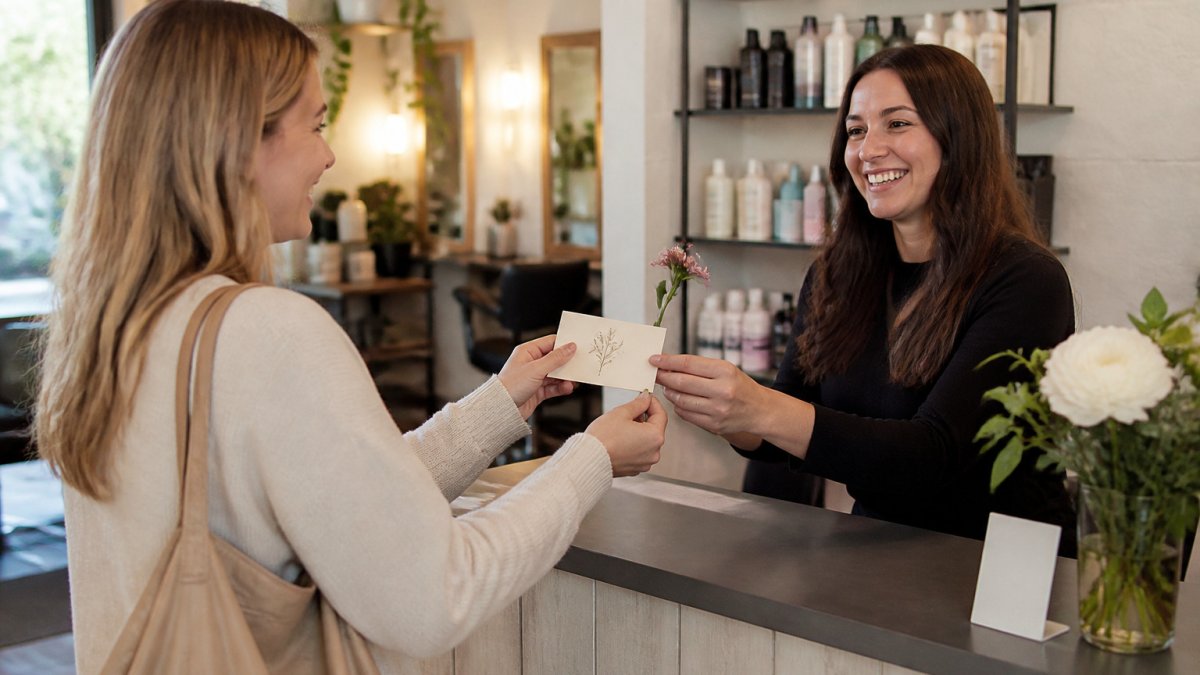
Personal rewards work best when they are specific. "Thanks for coming in" is generic. "Thanks for sending Maria in last month, we loved having her" reads as if someone paid attention. Recording which customer referred which friend makes this kind of detail possible.
Keep a short list of the reward types you can offer.
Customer Appreciation Ideas for Small Businesses
Appreciation can take many forms. Early access to a new service, a reserved spot at a seasonal event, or a priority slot when things get busy can signal that a customer matters.
Consider a regular-customer day, a small thank-you event, or a preview of something new before the public sees it.
Mention appreciation at the counter, on the receipt, or in a follow-up message.
Here is where appreciation and referral meet. A customer who sends you people is doing something harder than coming back herself. She is putting her own name behind yours. That deserves a different kind of thank-you than a visit counter. When a friend she sent completes a first visit, you can issue a Customer Reward by hand, or let the system issue it automatically. The reward is tied to the visit, so you are thanking her for something that actually happened.
A personal thank-you is a Customer Reward issued by hand.
Pro Tip Appreciation is not a discount. A handwritten note is one way to say thank you.One more idea that costs only attention: name the person who sent them. "Maria sent you? She's one of our favorites." The friend feels the connection, and Maria's name carries weight. That is appreciation working in both directions at once.
Customer Loyalty Program Ideas You Can Run Today
You do not need a complicated system to start. Three simple ideas can run on your existing setup this week:
- Visit counter: Give a small reward after a set number of paid visits. Staff can count visits at the counter without new software.
- Referral thank-you: Send a note to any customer whose friend completes a first visit.
- Seasonal welcome: Offer a short-term perk to customers who return during a slow period.
Choosing Rewards by Customer Segment
Not every reward fits every customer.
Start by sorting your customers into two or three groups based on how often they visit and how they arrived. Then match one reward type to each group. For example, offer priority to frequent visitors, a thank-you note to customers who referred someone, and a small welcome perk to recent first-time visitors.
Loyalty Rewards for Small Businesses on a Budget
Avoid rewards that create ongoing obligations you cannot sustain. A perk that is easy to offer now but expensive to honor later can damage trust when you have to withdraw it.
Measuring Whether Your Rewards Are Working
Most articles on rewarding loyal customers stop at ideas. This section is about the numbers, because a reward you cannot measure is a reward you cannot defend when money gets tight. The good news is that you do not need a finance team. You need three numbers and a habit of writing things down.
Start with cost per first visit. This is the metric that matters most when you reward referrals. Take everything you spent on rewards in a period, divide it by the number of first visits those rewards produced, and you have a number you can compare across reward types. If a thank-you note costs you a few minutes and brings in one first visit, and a discount costs you real margin and brings in the same one, the note wins. You will know who sent them, and you will know whether they came in.
Second, track how many customers reached each milestone. If you set a milestone at five referrals and almost nobody gets past two, the milestone is too far away. Lower it or add a smaller one in between. A milestone that is too far away feels like a lottery and stops motivating people.
Third, track how many customers used the rewards they earned. A reward that sits unused is not a thank-you; it is a cost with no benefit. If usage is low, the reward may be hard to use, unclear, or simply not worth the effort. Ask a few customers directly. Most will tell you.
-
Pick one reward type. A personal thank-you, a small add-on, or a milestone bonus.
-
Count first visits that came from referrals during that period.
A note on what to ignore. Vanity numbers like how many people opened a message or how many cards you handed out do not tell you whether the reward worked. The only numbers that matter are first visits, repeat visits, and what each one cost you. Everything else is noise.
Finally, be honest about what the numbers show. The visit looks different across service settings. Measure your own first visits.
Three numbers tell you whether a reward is worth its cost.
| Metric | What it tells you | Why it matters |
|---|---|---|
| Cost per first visit | Rewards spent divided by first visits produced | Compares reward types on the same footing |
| Customers reaching each milestone | How many reach each milestone | Shows whether the milestone is too far away |
| Customers using rewards earned | Whether earned rewards get redeemed | Unused rewards are a cost with no benefit |
| First visits and repeat visits | The only numbers that count | Vanity metrics like opens or cards handed out do not |
Frequently Asked Questions
How do you encourage customer loyalty?
Loyalty Rewards count paid visits, counted by staff at the counter. You set the visits that count and what customers earn. Milestone Rewards count referrals.
What are some creative ways to reward loyal customers without discounts?
A personal thank-you is a Customer Reward issued by hand. Your customers earn a Customer Reward when someone they sent completes a first visit.
How can a small service business reward repeat customers?
Loyalty Rewards count paid visits, counted by staff at the counter. Milestone Rewards count referrals. A personal thank-you is a Customer Reward issued by hand, and customers use the rewards they earn.
How can you measure whether a customer reward program is working?
Track first visits from referrals and cost per first visit. Milestone Rewards count referrals, and Loyalty Rewards count paid visits.